INPUT
one real customer problem.
write down who notices it, when it appears and what the current workaround costs in time, money or nerve.
GUIDE // 14 STEPS // EVIDENCE AWARE // 2026-07-18
the machines can multiply options. you still have to decide what deserves to exist.
001 // BEFORE SUMMONING ANYTHING
INPUT
write down who notices it, when it appears and what the current workaround costs in time, money or nerve.
TASTE
save the things you like. annotate the exact quality you want, then state what should not be copied.
BOUNDARY
assign one person to approve positioning, shortlist decisions, rights checks and the canonical kit.
plain text · no email · 14 steps · reviewed 2026-07-18
002 // THE WORKFLOW
each pass ends with a receipt. if the receipt is missing, the step is not done.
01
name one person, one costly or irritating problem and the moment they notice it.
AI HANDLES WELL
organize interview notes, cluster repeated language and expose contradictions in the brief.
HUMAN DECIDES
decide whose problem matters, what is true and which promise the product can actually keep.
receipt: one sentence: for [customer], [product] solves [problem] when [moment].
02
choose how the brand should feel before choosing what it should look like.
AI HANDLES WELL
turn broad adjectives into useful contrasts, consequences and possible contradictions.
HUMAN DECIDES
choose 3 perceptions the customer should leave with, then reject the ones the product cannot earn.
receipt: 3 perception words, each with one visible behavior and one thing the brand refuses.
03
collect references for their specific qualities, not because their logos happen to be nearby.
AI HANDLES WELL
label recurring patterns across references and group them by language, type, color, composition and behavior.
HUMAN DECIDES
pick the references, explain what attracts you and separate borrowed mood from copied execution.
receipt: 8 to 12 references with a short note saying what to keep and what to leave behind.
04
ask for distinct territories, not one swollen list of near-identical words.
AI HANDLES WELL
produce varied candidates against the audience, perception, taste and written constraints.
HUMAN DECIDES
keep the brief stable, reject generic constructions and notice when a surprising direction earns another pass.
receipt: several named territories, raw candidates and the prompt or input mapping that produced them.
05
reduce the field with the brief in view, before attachment turns one candidate into destiny.
AI HANDLES WELL
group similar candidates, check pronunciation prompts and assemble a consistent review sheet.
HUMAN DECIDES
judge memorability, tone, cultural fit and whether the name still works outside a generated result grid.
receipt: 3 candidates, written reasons for each and a visible record of what was rejected.
06
treat every generated name as a candidate until current records and appropriate advice say otherwise.
AI HANDLES WELL
prepare search queries, organize source links and keep a dated checklist of what was checked.
HUMAN DECIDES
inspect official records, recheck domains and handles, assess commercial risk and obtain qualified advice where needed.
receipt: a dated validation ledger with sources, unresolved conflicts and an explicit owner for the final decision.
07
translate perception and taste into 2 or 3 directions that can be compared for the same job.
AI HANDLES WELL
assemble contrasted art directions, reference labels and concrete visual rules from the approved brief.
HUMAN DECIDES
choose the direction that carries the intended perception, not the one with the loudest first impression.
receipt: one selected direction with references, exclusions and a sentence explaining why it fits.
08
make a mark that survives the places it must actually live.
AI HANDLES WELL
generate explorations, create controlled variations and place directions into relevant mockups.
HUMAN DECIDES
inspect letterforms, small sizes, monochrome use, resemblance, production needs and any rights or licensing questions.
receipt: a chosen construction, rejected variants and a list of required production files that have been verified in hand.
09
turn a promising image into repeatable rules for text, interface, print and small screens.
AI HANDLES WELL
suggest pairings, document tokens and generate test layouts using the selected direction.
HUMAN DECIDES
check readability, contrast, font licensing, technical availability and whether the palette still works without the hero image.
receipt: named type roles, color tokens, contrast checks and fallback choices.
10
give the brand a stable way to speak before drafting 40 disconnected headlines.
AI HANDLES WELL
draft message variants, test them against the positioning and expose phrases that sound generic or unsupported.
HUMAN DECIDES
own the worldview, truth conditions, humor, claims and lines the brand will not cross.
receipt: one positioning line, one plain description, 3 proof points, voice rules and banned language.
11
write the decisions down so another person or machine can reproduce the system without guessing.
AI HANDLES WELL
compile the approved rules into a structured document and flag missing or contradictory fields.
HUMAN DECIDES
resolve contradictions, verify usage and licensing notes and mark every unknown that still needs an owner.
receipt: one versioned file covering positioning, name, logo use, type, color, voice, examples, boundaries and source assets.
12
put the brand around one real offer, one audience and one useful next action.
AI HANDLES WELL
draft page structure, copy variants, component states and implementation notes from the approved kit.
HUMAN DECIDES
choose the promise, evidence, conversion path and operational behavior after someone responds.
receipt: a working launch surface with a real offer state, contact path, legal pages and measured events.
13
find where the system changes personality between the page, logo, message, social crop and email.
AI HANDLES WELL
compare assets against the kit, list deviations and run repeatable accessibility and consistency checks.
HUMAN DECIDES
decide which exceptions are intentional, test comprehension with real people and correct the rest.
receipt: a cross-surface review with pass, fail and intentional-exception states.
14
release the smallest coherent system, then learn from behavior instead of decorating in private forever.
AI HANDLES WELL
summarize analytics, group support language and propose bounded tests against an explicit baseline.
HUMAN DECIDES
decide which signal matters, protect the core identity and approve every change to the canonical kit.
receipt: a dated launch, baseline metrics, a feedback log and one prioritized next test.
003 // WORKED EXAMPLE // EVIDENCE STATES INCLUDED
this example covers all 14 steps using the canonical private-markets brief and recorded input mappings. north ledger is synthetic test text. it is not a recommendation, availability result, ownership claim or launch-ready identity.
01
recorded
an AI research and monitoring product for private-market investment teams. the recorded audience is investment professionals at private equity and growth equity firms.
02
recorded
precise, sober and high-trust. more institutional than futuristic.
03
recorded
the canonical attractors are quiet authority, modernist publishing, blackened steel, london, private not secret. the house mapping records exact live substitutes where the taxonomy differs.
04
recorded
namelix returned one preserved first set for this brief. the house name picker input was mapped but generation was not started under the no-spend rule.
05
not completed
no 2-reviewer shortlist exists. north ledger is retained only as synthetic test text for the later visual mapping, not as a recommended or selected name.
06
not completed
domain, handle, business-name and trademark clearance remain unresolved. no badge or generated suggestion is treated as proof.
07
recorded
the mapped input direction uses london underground, airport departures board, mechanical monospace, app icon first, ink on paper, moonlight, trading terminal, app icon, not tech bro. these are recorded taxonomy choices, not a quality verdict.
08
not completed
the logo input was mapped, but no model-backed output was generated, exported or approved. the example therefore publishes no invented mark.
09
editorial demo
mechanical monospace, ink on paper and moonlight are the recorded input labels. a production type license, exact font stack, color values and contrast checks still need human approval.
10
editorial demo
the working voice is precise, sober and high-trust, with institutional language ahead of futuristic theater. no product-performance claim is added to the example.
11
editorial demo
the checklist below provides the portable structure. no generated brand-kit prompt was produced for this brief under the no-spend rule.
12
editorial demo
the smallest editorial test surface is one page for the recorded audience with one plain product description, one evidence block and one next action. it has not been built or published.
13
editorial demo
the review would compare the brief, name state, visual rules, copy, small-screen mark and launch page. unresolved legal, font and output states remain failures, not quiet assumptions.
14
not completed
the example has no live launch, users, analytics or performance result. the next valid move is to finish human review and validation before establishing a real baseline.
THE RECORDED FIRST SET
the screenshot proves a first result set appeared. it does not prove name quality, availability, originality or legal safety.
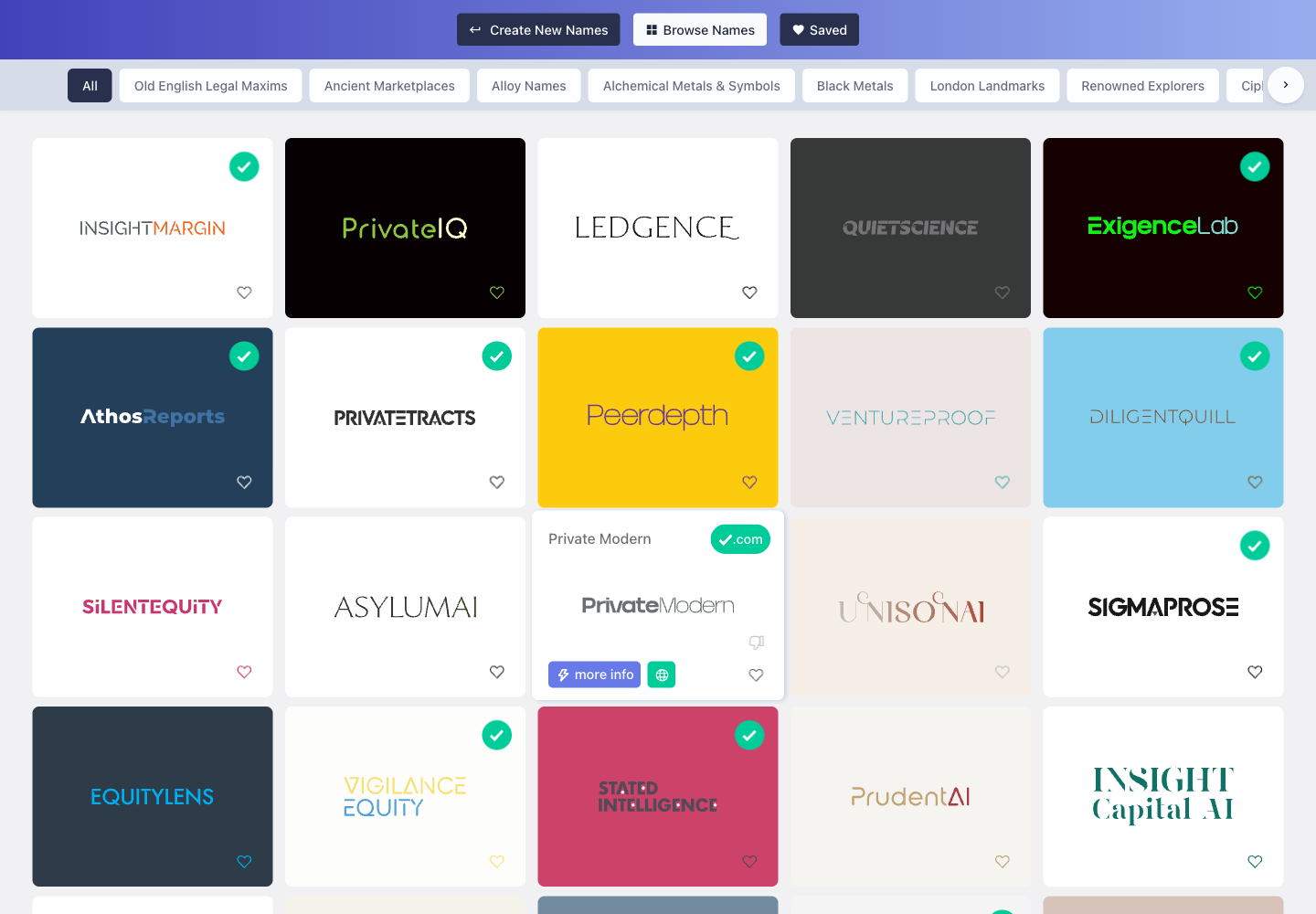
the first visible namelix result set for the AI finance brief, before any saving, feedback or repeated generation.
limits: the generated logo treatments visible on result cards were not evaluated. domain-badge availability was not independently rechecked.
004 // LIMITS
005 // QUESTIONS BEFORE THE NEXT PROMPT
AI can help organize a brief, expand options, generate directions and check a system for drift. people still decide what is true, tasteful, legally acceptable and worth launching. this guide treats AI as a fast studio assistant, not the owner of the positioning or final approval.
decide the customer, problem, desired perception, useful taste references and written constraints first. a naming prompt without those decisions invites generic output. keep that brief fixed while comparing directions so a change in result can be traced to the tool or the input.
do not let one convenient domain make the whole naming decision. generate and shortlist names against the brief, then check current domains alongside business-name, handle and rights research. availability signals can narrow the field, but this benchmark does not treat them as ownership or legal clearance.
this guide cannot determine whether a specific name or logo can be registered or safely used. treat every output as a candidate, search current official records and get qualified advice where the decision carries material risk. generated files are creative directions, not a rights opinion.
sometimes. specialist help is useful when the identity needs original judgment, production-ready files, rights or licensing coordination, complex accessibility work or a consistent rollout across many surfaces. a generated direction can clarify the brief without replacing every piece of professional review.
there is no single bundle for every brand. a useful portable kit should include the approved brief, name state, logo files actually received, type and color rules, voice, messages, usage examples, known restrictions and links to source assets. label missing exports instead of listing imaginary files.
keep one versioned brand kit as the source of truth. require every new asset to name the approved direction, tokens, voice rules and exclusions, then compare the result against them. record intentional exceptions. otherwise the gods of compute will discover a new personality on every prompt.
start with your own brief, free public tools where their limits fit, and the downloadable markdown checklist on this page. AI brand scaler lists its name and logo interfaces as free, but v0.1 does not compare total workflow cost or output quality. spend only when a verified need appears.